Gas detectors are currently one of the most widely used products in various hazardous areas with potential gas explosion risks. When consulting STS about the Ex certification of gas detectors, many customers are often uncertain about or unfamiliar with choosing between flameproof "d" and intrinsically safe "i" explosion-proof technologies. To address such doubts, STS will provide a brief explanation of these two explosion-proof technologies for gas detectors.
Whether a gas detector should adopt the flameproof or intrinsically safe design the key factor lies in the product's structure, installation method and intended application area.
For portable and hand-held gas detectors, the intrinsically safe design is recommended for its light weight. In addition, gas detectors intended for use in Zone 0 can only adopt the ia protection level of intrinsic safety. However, the intrinsically safe design has one key requirement: the product's circuit diagrams must be provided, and the circuit design must comply with the technical requirements for intrinsic safety.
Fixed gas detectors may adopt the flameproof design. Flameproof products are relatively bulky, as they use a dedicated flameproof enclosure to protect the internal electrical circuits. Even if the internal circuits face a risk of deflagration, the flameproof enclosure can effectively contain the propagation of an explosion.
In addition, for battery-powered gas detectors, the temperature rise test of the battery must be taken into account when applying for Ex certification.
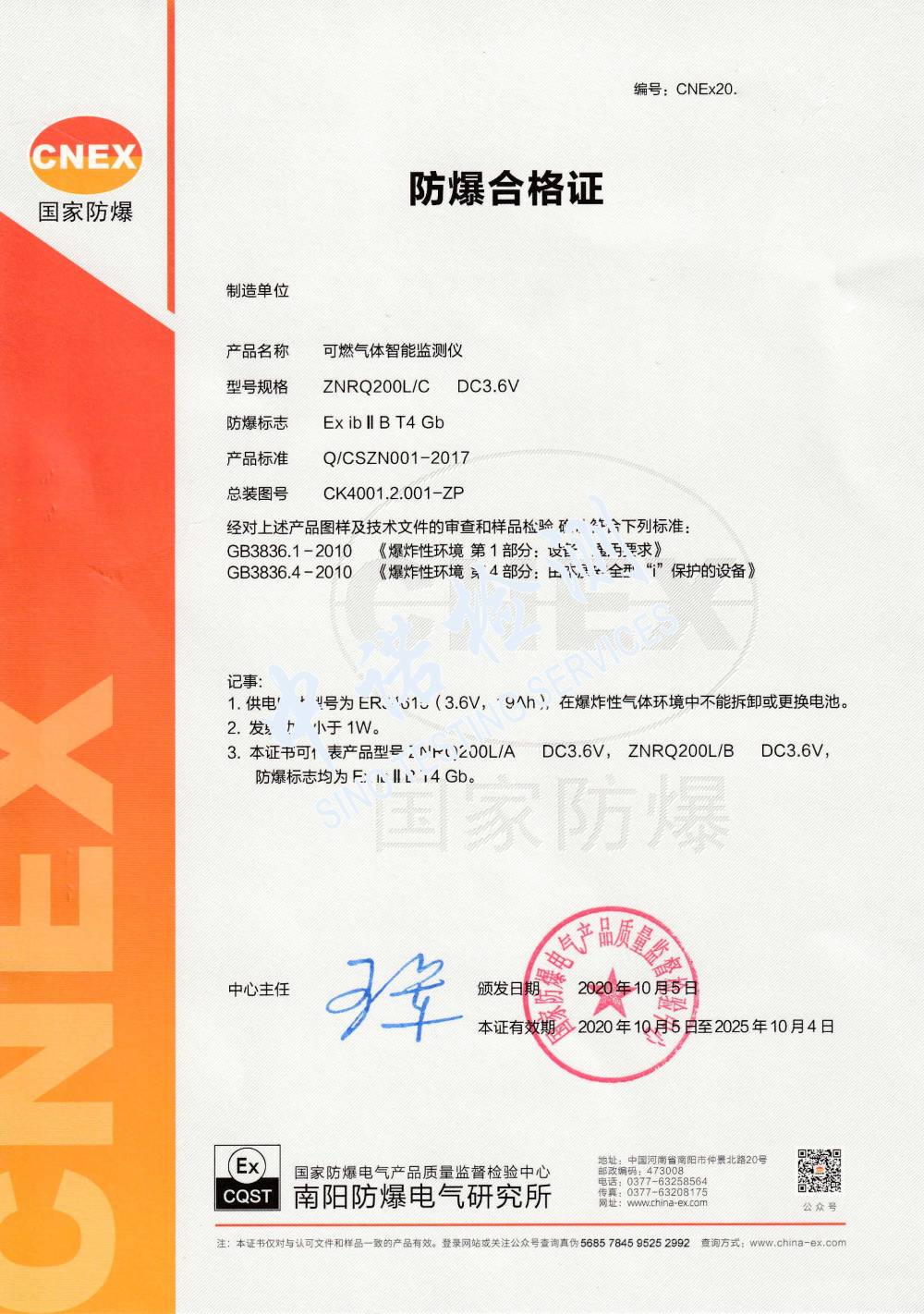
Up to now, STS has successfully helped customers obtain domestic Ex Certificates, ATEX certification and IECEx certification for gas detectors.



 |
||||||
 |
||||||
|
||||||
 |
||||||
|
||||||
 |