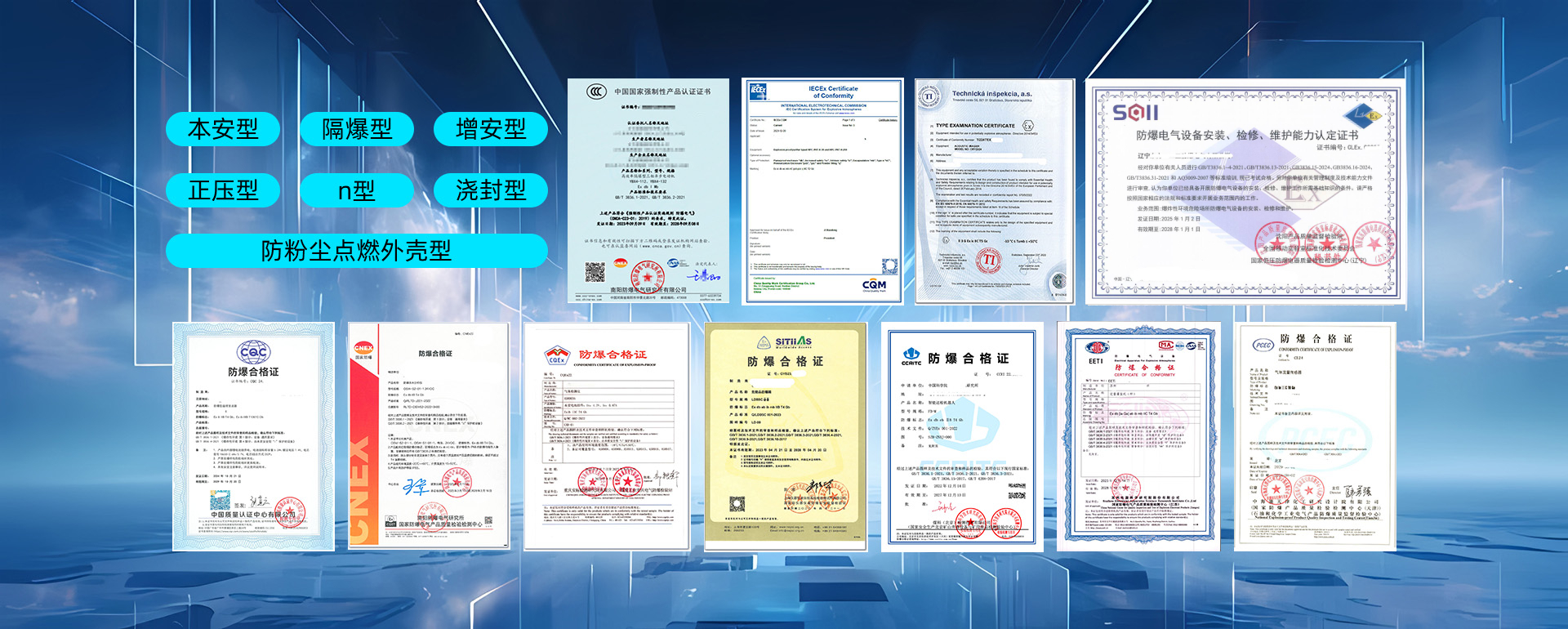
The North American Explosion-Proof Certification System (hereinafter referred to as the NEC System) differs significantly from China's explosion-proof certification system based on the national standard system (hereinafter referred to as the GB System) in terms of the classification and grouping of explosive substances, the classification of hazardous locations, explosion-proof protection methods, installation and wiring, etc. Although the National Electrical Code (NEC) in the United States has gradually adopted the zone classification system for hazardous locations specified in the IEC 60079 series of standards (corresponding to China's GB/T 3836 series of national standards) since its 1996 edition, and relevant American product standards have been revised and supplemented accordingly, manufacturers of explosion-proof electrical products familiar with China's explosion-proof certification system, as well as users in petrochemical and other industries that widely use imported products, are still confused by a series of issues regarding the North American classification system, including the design, manufacturing, installation, application, and rational selection of explosion-proof electrical products under China's explosion-proof certification system. In particular, manufacturers aiming to enter the North American market are eager to understand the differences between the two standard systems to successfully enter the market.
I. Differences in Location Classification
1. Differences in the Classification and Grouping of Explosive Substances
2. Differences in the Zone Classification of Explosive Locations
3. Differences in Temperature Classes
II. Differences in Protection Methods
Differences in Protection Methods and Scope of Application Between the North American NEC System and China's GB System
Flameproof Type
Intrinsic Safety Type
In the NEC System, the intrinsic safety type corresponds to the intrinsic safety Type ia in the GB System.
There is no intrinsic safety Type ib in the NEC System; in the GB System, it is only applicable to Zone 1.
In terms of structural requirements, it is equivalent to the "non-incendive circuits" and "non-incendive components" specified in the NEC System.
Increased Safety Type: This protection method is not available in the NEC System.
Non-Sparking Type: This protection method is not available in the NEC System.
Encapsulated Type: In the NEC System, this method is only used for local protection or component protection.
Special Type: This protection method is not available in the NEC System.
III. Differences in Installation Methods
IV. Marking Comparison of the Two Systems
NEC System: Class I, Division 1, Group C, T6
GB/IEC System: Ex db IIB T4 Gb
V. Standard Comparison of the Two Systems
China/IEC Explosion-Proof System: GB/T 3836 and IEC 60079 series of standards
NEC Explosion-Proof System: UL Standards
Note: In the North American standard system, explosion-proof product standards are classified by specific types of products, such as ANSI/UL 894 (Switches for Hazardous Locations). In contrast, the GB standard system is classified by explosion-proof types. The explosion-proof product standards in the NEC System not only specify requirements for explosion-proof structures but also regulate product performance related to explosion-proof safety.

 |
||||||
 |
||||||
|
||||||
 |
||||||
|
||||||
 |



.jpg)