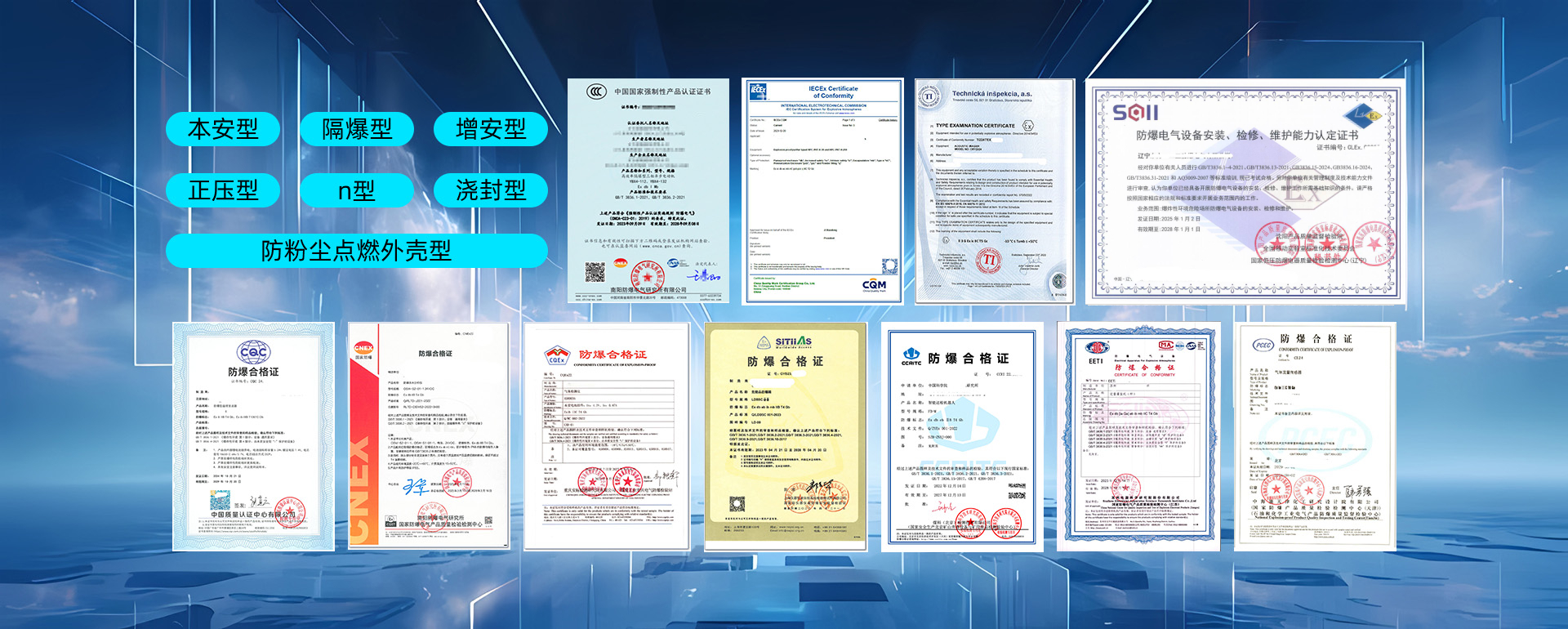
Ⅰ.Dust Explosion-Proof Certificate
A dust explosion-proof certificate is a legal document proving equipment can operate safely in explosive dust atmospheres. It falls under Group III explosion-proof certification and is only issued upon passing relevant type tests, serving as a "passport" for equipment to be used in hazardous locations.
It differs from Group I certificates for underground coal mines and Group II certificates for petrochemical gas environments. The three types of certificates are not interchangeable; selection must match on-site hazardous substances.
Ⅱ.Applicable Environments
Designed exclusively for non-mining explosive dust areas, including flour mills, coal powder plants, spray booths, polishing workshops, feed mills, food processing factories and other sites with combustible dust.
Ⅲ.Applicable Standards
GB/T 3836 series standards (e.g., GB/T 3836.31 Dust Ignition Protected Enclosure). The former GB 12476 series has been superseded.
Ⅳ.Common Explosion-Proof Types
● Intrinsically safe "i"
● Pressurized "p"
● Encapsulated "m"
● Dust ignition protected enclosure "t"
Ⅴ.Hazardous Zones Classification
Zone 20: Highest risk. Persistent or frequent dust clouds form during normal operation, such as inside dust silos, mixers and pulverizers.
Zone 21: Medium risk. Dust clouds may occasionally occur under normal operation, such as areas adjacent to dust vessels and zones liable to disturbed dust layers.
Zone 22: Low risk. Dust clouds only appear briefly and occasionally under abnormal conditions, such as rarely opened compartments and joints of pneumatic equipment.
.jpg)


.jpg)


 |
||||||
 |
||||||
|
||||||
 |
||||||
|
||||||
 |